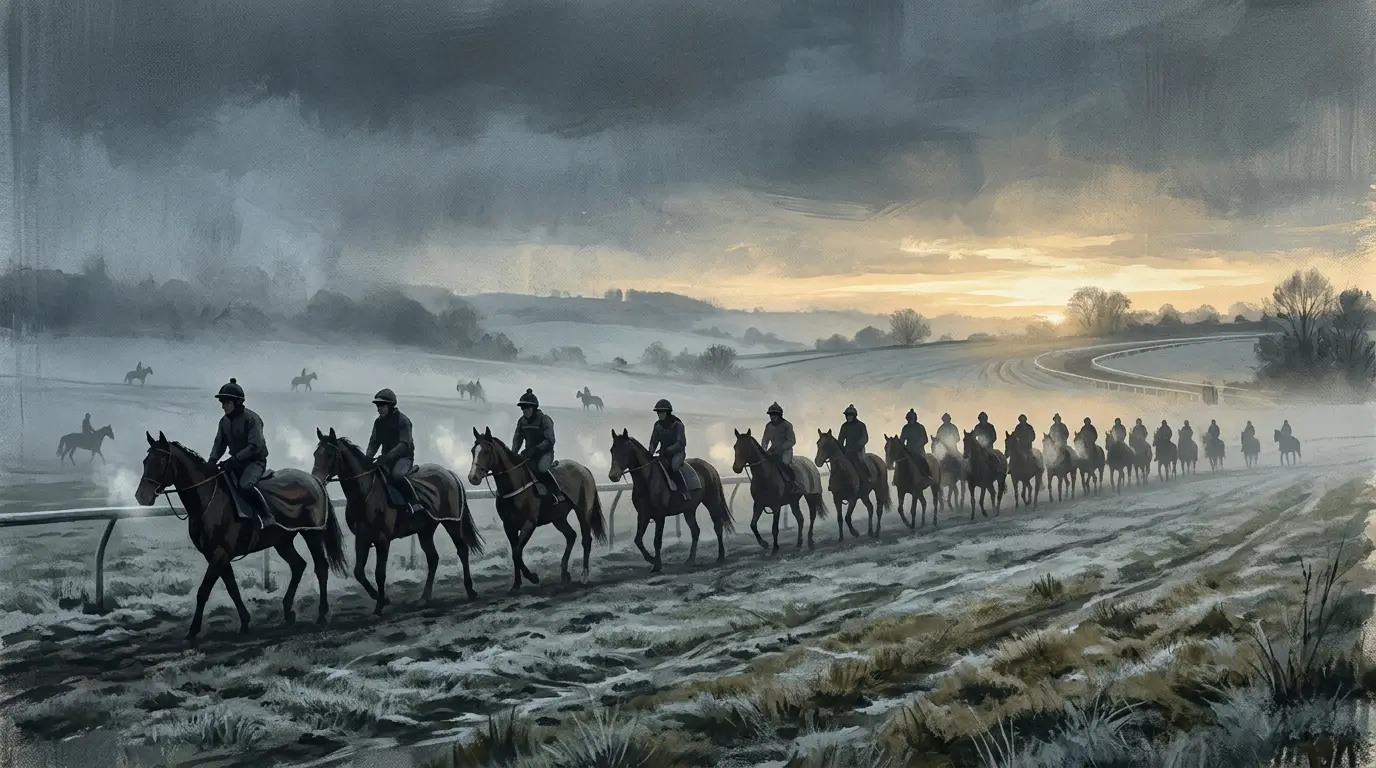
There are places in Britain where racing is a sport, and there is Newmarket, where it is the entire economy, the architecture, the rhythm of the day. To understand how stable information moves — how a private impression formed on the gallops at dawn becomes, weeks later, a quiet contraction in a betting market — it helps to understand a town built entirely around horses. Newmarket is not where racing happens to take place. It is where racing lives, and where the whispers begin.
Some 3,500 horses are trained here at any given time, across dozens of yards, worked over thousands of acres of manicured heath that has been used for the purpose for four centuries. The town exists in service of them. The result is a concentration of knowledge unmatched anywhere in British racing — and a network of people who carry that knowledge, often without ever intending to trade in it.
The Town That Wakes Before Dawn
The Newmarket day begins in darkness. By the time most of Britain is asleep, the strings are pulling out — long lines of horses making their way from the yards through the town and out onto the gallops, lads and lasses muffled against the cold, the only sound the clatter of hooves on the walkways that thread between the roads.
It is on the heath, in those first grey hours, that the rawest racing intelligence is formed. A work rider feels a horse travel within itself, doing easily what should have stretched it. A trainer watches a once-fragile gelding finally move with freedom. A two-year-old, barely raced, works upsides a proven performer and is not found wanting. None of this is written down. None of it appears in any form book. It exists only as impression, held in the minds of the small number of people who were there to see it.
This is the source. Everything downstream — the market move, the whisper passed between friends, the confident note in a trainer’s voice when asked about a horse’s chance — flows from these private moments on the heath that the public never sees. As we’ve discussed in the value of watching morning work, interpreting it is a skill of its own. But Newmarket is where so much of it originates.
How Knowledge Becomes a Whisper
Knowledge, in Newmarket, is not kept in vaults. It is carried by people, and people talk. Not recklessly — the genuinely useful sources understand the value of discretion, and a stable lad who broadcasts everything he sees finds the information drying up quickly. But a training town is a small world. The same faces appear in the same cafés at the same early hours. Riders move between yards over the years. Families have worked in the industry for generations. Knowledge seeps, slowly and selectively, through a dense web of relationships built over decades.
A whisper, in this sense, is rarely a single dramatic revelation. More often it is an accumulation — a tone, an absence of the usual caution, a horse being spoken of more warmly than its form would suggest. Those attuned to the town’s rhythms learn to read these subtleties. They are not buying tips; they are reading a community that knows its own horses intimately and cannot entirely conceal what it knows.
The danger, of course, is amplification. We’ve written before about the echo chamber effect, and a training town is fertile ground for it. A modest, accurate impression — “he’s working nicely” — can pass through a dozen retellings and emerge as something far more emphatic than the original observation ever justified. The discipline of the serious observer is to seek the source, not the echo, and to weigh information by the reliability of who carries it rather than by how loudly it arrives.
The Heath as a Closed System
What makes Newmarket distinctive is that it is, in informational terms, almost a closed system. The horses are trained here, worked here, and much of the knowledge about them is held here, within the town’s boundaries, for a long time before it reaches the wider world. A horse can work brilliantly on the Limekilns in February and not reveal that ability on a racecourse until April. For those two months, the truth about that horse lives in Newmarket and almost nowhere else.
This is the structural reason a training town generates such valuable intelligence. The information advantage is not a matter of secrecy or impropriety — it is simply geography and time. The people who see the horse every day know it better than any form line can convey, and there is an unavoidable lag before that private knowledge becomes public fact. It is in that lag that genuine edges exist, for those positioned to perceive them.
When the knowledge finally does begin to move — when a horse is entered, declared, and primed for its target — it often shows first not in any public statement but in the market itself. The steady, unexplained contraction we’ve described elsewhere is frequently the visible surface of something that was understood in Newmarket weeks earlier. The market is the last link in a chain that began on the heath in the dark.
Lambourn, the Curragh, and the Wider Map
Newmarket is the largest and most famous of Britain’s training centres, but it is not the only one. Lambourn, tucked into the Berkshire downs, serves as the spiritual home of much of British jump racing and operates on the same principles — a concentrated community, an intimate knowledge of its horses, the same dawn rituals on the gallops. The Curragh in Ireland plays a comparable role across the Irish Sea, and the flow of information between Irish training centres and British betting markets is, as we’ve noted, one of the most significant dynamics in the sport.
Each of these places functions as its own whisper network, its own closed system of knowledge with its own rhythms and its own reliable and unreliable voices. The principle is universal even where the geography differs: where horses are trained in concentration, knowledge concentrates too, and a portion of it inevitably leaks — quietly, selectively, and always ahead of the public.
Reading the Town Without Living in It
Few who follow racing will ever stand on the Newmarket gallops at dawn. The good news is that you do not have to live in a training town to benefit from understanding how one works. The lesson is in the structure: that genuine intelligence forms privately and early, that it moves through people rather than announcements, that it is best weighed by source rather than volume, and that it surfaces in the market before it surfaces anywhere public.
Understanding that chain — from the impression on the heath, through the network of those who carry it, to the eventual movement in the price — is what separates reading a market with insight from merely reacting to it. The whispers of Newmarket have shaped British racing for four centuries. They are quieter than the racecourse roar, and infinitely more informative, for those who learn to listen for them.
Disclaimer: Gambling can be addictive and should only be undertaken responsibly by adults. Never bet more than you can afford to lose. For help with problem gambling, contact BeGambleAware (0808 8020 133) or GamCare. StableWhispers.co.uk provides information and entertainment but does not guarantee returns. All betting carries risk. 18+ only.

Leave a Reply